Choose the next constraint.
More production, more housing, military capacity, civic authority, trade, research, or defence—every branch solves a different problem.
 PHRATEKETERNAL DYNASTIES
Architecture of a dynasty
Every structure spends resources, every worksite needs citizens, and every hour committed to infrastructure gives rivals time to advance their pyramids. Build the village your strategy actually needs.
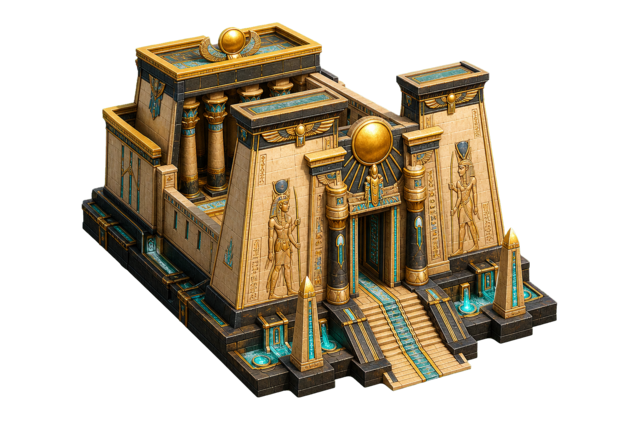
The construction queue
Your village runs one construction project at a time. Choose a valid crew, pay the resources up front, and decide which bottleneck matters most. Completed infrastructure also contributes to the Gold maintenance charged each game month.
More production, more housing, military capacity, civic authority, trade, research, or defence—every branch solves a different problem.
Each structure accepts a different crew range. Larger crews shorten the build, with diminishing returns, while those citizens remain unavailable elsewhere.
Some buildings allow several sites, while civic landmarks remain unique. Higher levels cost more, but deepen the purpose of the structure.
I / Production
Production buildings turn working-age citizens into four stored resources. Every completed producer level contributes storage as well as worker room and output, so additional sites remain strategically useful.
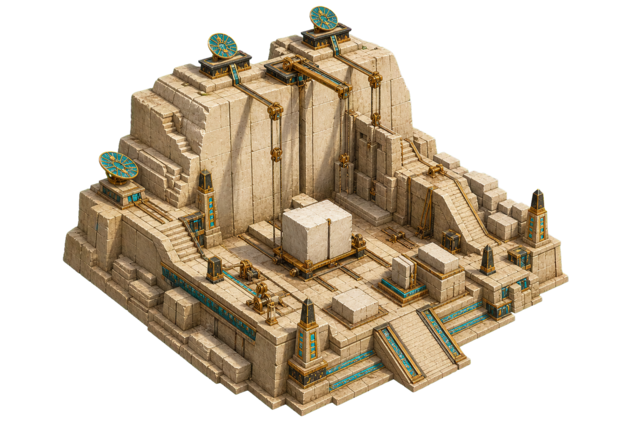
Limestone production
The workhorse of expansion and Ascension. Quarry crews cut the stone consumed by buildings and the five phases of the pyramid.
Level I supports 100 workers and contributes 4,500 Limestone storage; every completed level adds its own storage.
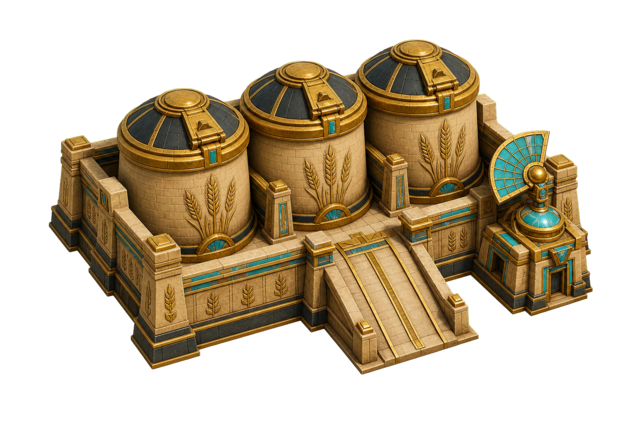
Grain production
The foundation of daily survival. Grain sustains citizens, builders, and troops, so a neglected harvest can undo the grandest plan.
Level I supports 200 workers and contributes 5,000 Grain storage; additional sites add their capacity independently.
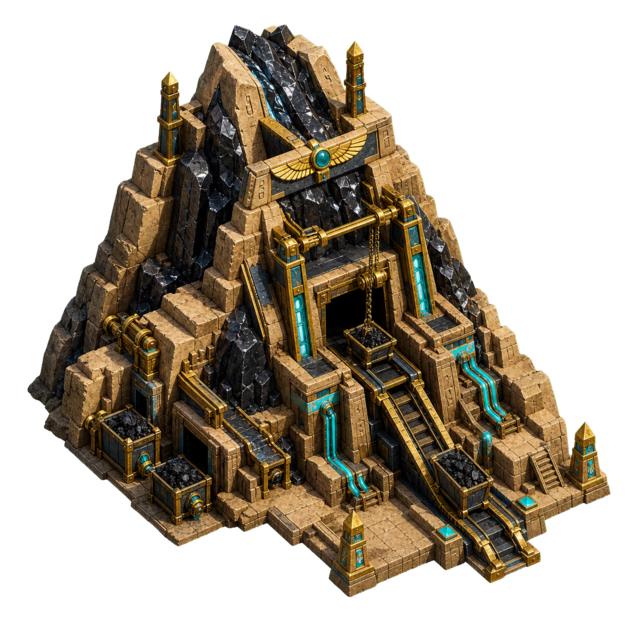
Obsidian production
Rare black glass drives advanced construction, troops, covenants, and the most efficient pyramid reserves.
Level I supports 60 workers and contributes 2,250 Obsidian storage; damage can reduce output but never removes storage.
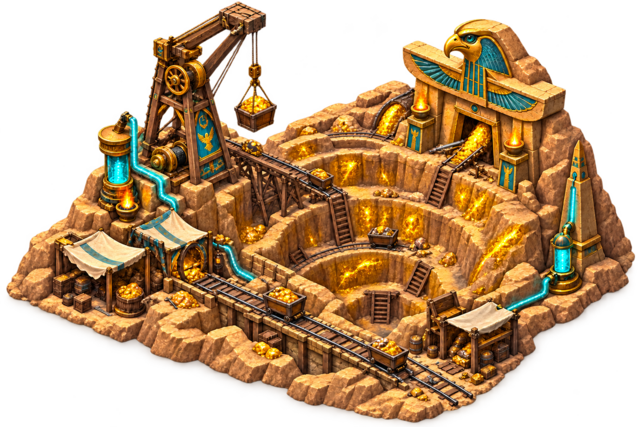
Gold production
Extract the treasury resource used for civic maintenance, divine tribute, troop training, and merchant voyage fees.
Level I supports 30 workers and contributes 450 Gold storage. Every Alpha 1.3 village begins with one completed mine.
II / People & army
Population is both your strength and your pressure. House it, decide how much of it can leave civilian work, and prepare for rivals who see an undefended storehouse.
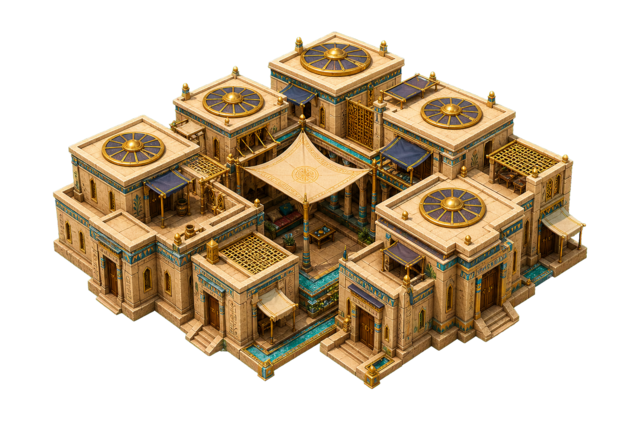
Housing
A growing dynasty needs room for children, workers, and elders. Housing pressure reaches beyond comfort and into long-term population health.
Every completed residence level adds housing for 250 citizens to the village’s base capacity.
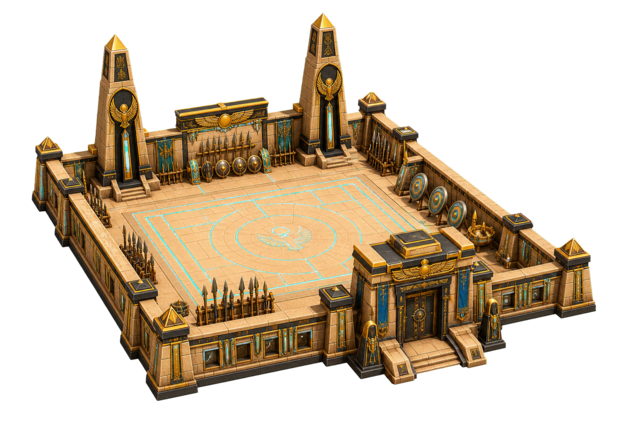
Troop training
Turn available recruits into spearmen, archers, and chariots. Every unit costs Gold as well as material resources.
Each completed site runs five training slots in parallel; higher levels reduce the time each unit needs.
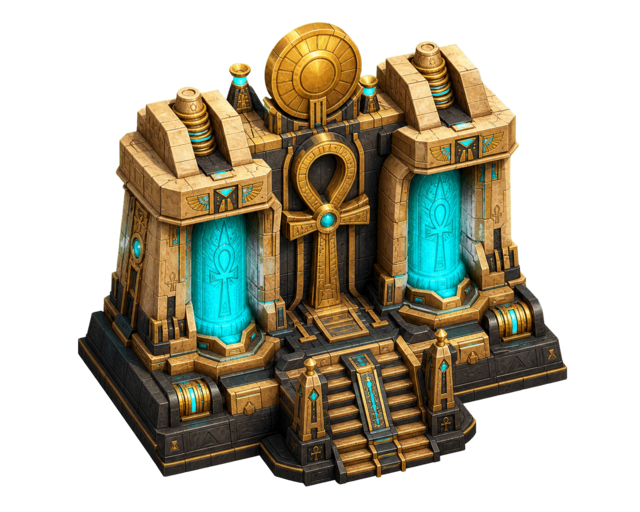
Civic landmark
Each completed level increases population growth by 3%. More future citizens strengthen the workforce, but they also increase housing and grain demand.
Each site reaches Level V; the settlement-wide growth bonus is capped at 50%.
III / Civic & knowledge
These landmarks open machine-god bonuses and policies. They also unlock temporary prophecies, trade voyages, and research. Each option consumes resources or time that could support another plan.
Divine covenant
Build Level I to choose one of twelve machine-gods. Annual Gold tribute sustains the favour behind that covenant.
Levels above I reduce the yearly tribute quote by 5% each, capped at 20%; this unique landmark can rise to Level V.

Personal prophecy
A chamber tuned to momentary possibilities. Its signal lets a ruler choose a temporary blessing for the current game year.
Level I unlocks one invocation per game year from 10 personal prophecies; four global signals and one milestone complete the fifteen-prophecy catalogue.

Village policy
Where prosperity, pressure, labour, and defence become law. Policies shift one part of village life by accepting a cost elsewhere.
Level I opens the council: up to two policies may be active, with 24 hours between changes.
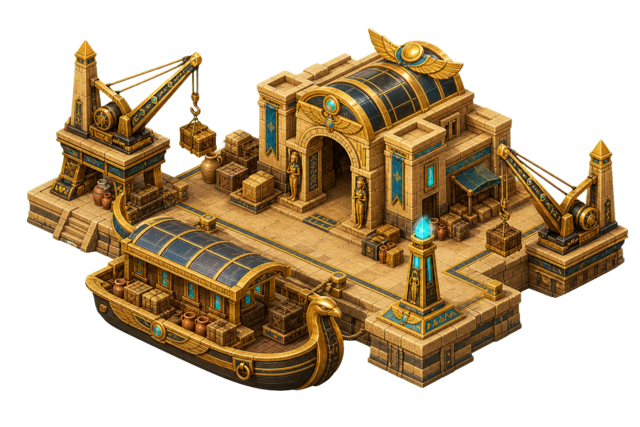
Resource exchange
Send limestone, grain, or obsidian downriver and receive the resource your current plan lacks. Gold cannot be cargo.
Every outbound voyage deducts a Gold fee at dispatch; more sites and levels add capacity and shorten travel time.

Research
Recover twenty technologies through five foundations and the connected Industry, Civic, and Dominion branches.
Level I opens research; each level above I adds 10% speed, capped at a 1.5× Library multiplier.
IV / Defence
A strong economy attracts attention. Fortification does not win the Ascension race alone, but it changes what rivals must risk to interrupt you.

Village defence
A black-glass warning above the village. Each completed tower level increases defensive strength when a raid is resolved.
A dynasty may raise up to three tower sites, each with a maximum of eight levels.
The Temple changes the plan
Choose one of twelve divine strategies, then honour the annual tribute that keeps its boon strong and its burden contained.
Plan your first building
Start your dynasty, balance one construction queue, and turn thirteen building types into a clear path to Ascension.
Optional analytics
Analytics help us understand which public pages and controls are useful, whether visits lead to account creation or sign-in, which gameplay actions succeed or fail, and where errors happen. We use random browser and visit IDs that are not linked to your Phratek account. Saying no will not affect the website or game.
Names, email addresses, passwords, account, village, world or rival IDs, messages, form values, map coordinates, raw errors, query strings and IP addresses are not added to the analytics dataset.
The random browser ID rotates after 30 days. Accepted raw events are retained centrally for 90 days. When delivery must be retried, the unsent browser queue is capped at 1,000 events or 5 MiB.