
Limestone
The bulk of ambition
Used across village construction and accepted by the pyramid at one construction power per unit.
Starting reserve · 500 · L1 capacity 5,000 PHRATEKETERNAL DYNASTIES
A living strategy game
People age. Grain is eaten. Crews leave the fields to build. Armies draw from the same population that powers the economy. Every system meets at one question: how much can you commit to Ascension without leaving the dynasty exposed?

The strategic loop
Phratek’s systems do not sit in isolation. Every worker moved, building started, voyage dispatched, and troop trained changes what the village can do next.

Put available adults into production, construction, monument crews, or military service.
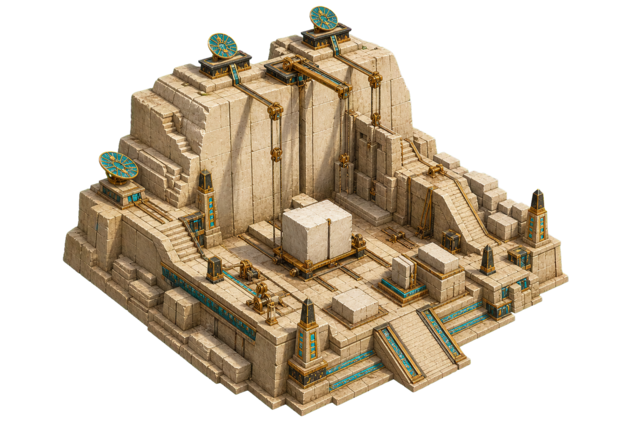
Use production to raise and upgrade structures, opening stronger economic and civic choices.
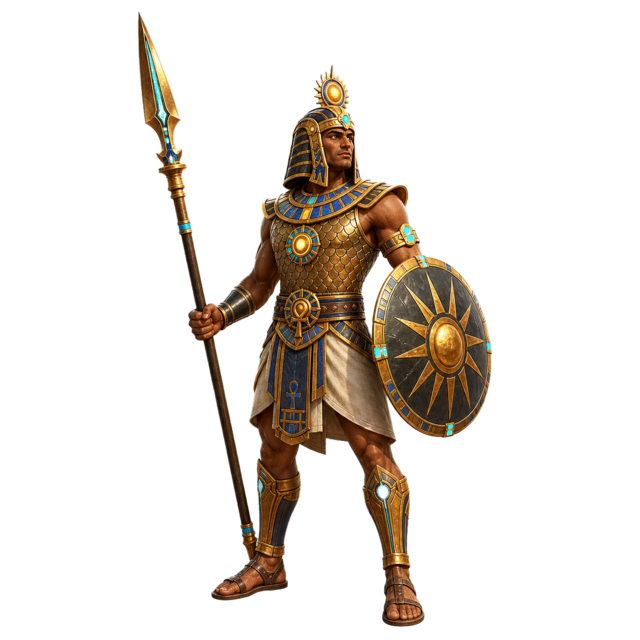
Trade and negotiate when interests align; train defenders or launch a raid when they do not.
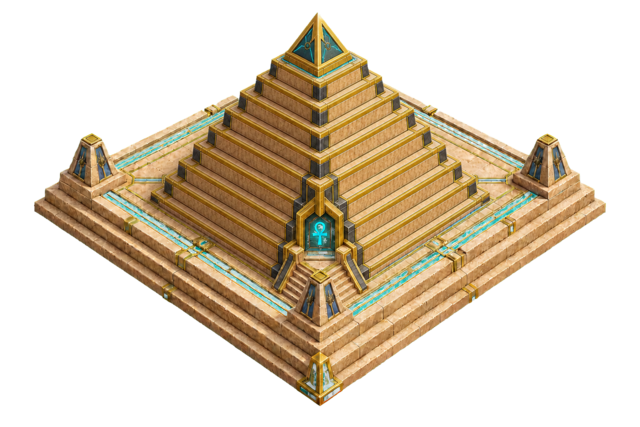
Reserve limestone and obsidian, assign pyramid workers, and advance through five phases.
Time & population
The world clock divides each game year into twelve monthly ticks. Citizens age at the turn of a year, while births, mortality, migration, civic maintenance, and happiness changes are resolved month by month.
Ages 15 through 64 form the working population. Children and elders still consume grain, while housing limits new births. Happiness affects births and production. Health affects mortality and annual happiness drift: health below 60 applies the harsher drift.
Each monthly cycle leaves an immutable ledger of population before and after, births, deaths, migration, housing, nutrition, happiness, health, and the modifiers that shaped the result.
With food and housing fully supplied, the Year 43 population model targets about 1,800 citizens at 40 happiness, 2,600 at 70, and 3,500 at 100. Upgraded villages can also admit balanced adults from a five-year migration-recovery pool when spare housing and the preceding nutrition cycle allow it.
Population ledger
When current harvest fully covers consumption, health recovers by 0.15 per real hour up to 100. Empty granaries with unmet demand lower health and happiness in proportion to the shortage.
Workforce & resources
Production is driven by assigned workers, completed producer levels, happiness, and active modifiers. Each resource has a base storage allowance; total capacity grows with every completed matching producer level and research. Multiple sites add independently, and an above-cap balance remains spendable while new output pauses.
Limestone
Used across village construction and accepted by the pyramid at one construction power per unit.
Starting reserve · 500 · L1 capacity 5,000
Grain
Feeds citizens in every role and also funds construction, training, research, and other commands.
Starting reserve · 1,000 · L1 capacity 6,000
Obsidian
Required by advanced structures and troops; each unit reserved for the pyramid supplies two construction power.
Starting reserve · 250 · L1 capacity 2,500
Gold
Pays civic maintenance, annual divine tribute, troop training, and outbound voyage fees. Gold can be gifted or raided, but it cannot be a trade-route commodity.
Starting reserve · 50 · L1 capacity 500Development systems
Infrastructure, knowledge, trade, divine allegiance, and civic policy each open a different route to strength—and each consumes time or resources that could have gone elsewhere.
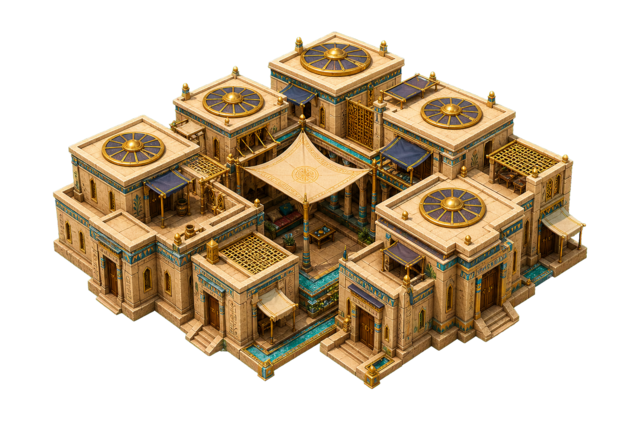
Construction
Only one building upgrade can occupy the construction queue. Crews complete tracked work at a rate proportional to the square root of their size, so legal reassignment and construction-speed effects immediately change the projected finish. A zero crew pauses without losing work or materials.
Explore all thirteen structures →
Knowledge
A Library of Knowledge unlocks 20 technologies: five foundations followed by connected Industry, Civic, and Dominion branches. The library studies one project at a time, prerequisites matter, and the complete programme cannot be compressed below thirty real days.
Trade
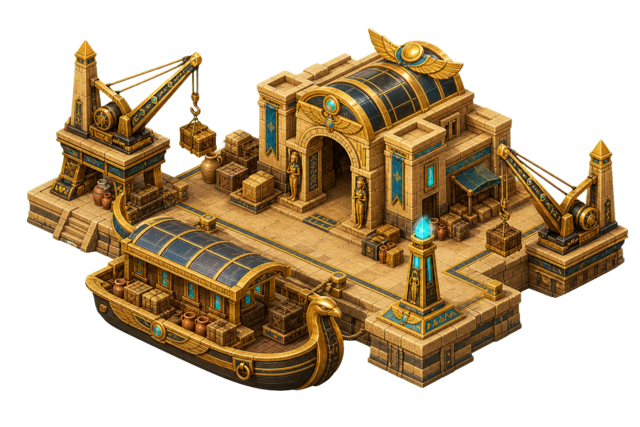
A Trade Port opens timed merchant routes between grain, limestone, and obsidian. Gold is never cargo: each outbound voyage freezes and deducts a fee of ceil(5 + exported units × 0.01) Gold, then reserves a berth and consumes its export.

Machine-god, favour & prophecy
Build the Temple to choose one of twelve machine-gods. A Gold tribute quote freezes each year; payment restores favour at year-end, while a missed tribute weakens boons and intensifies burdens. Council policy and the 15-prophecy catalogue can reinforce the plan.
Meet the machine-gods →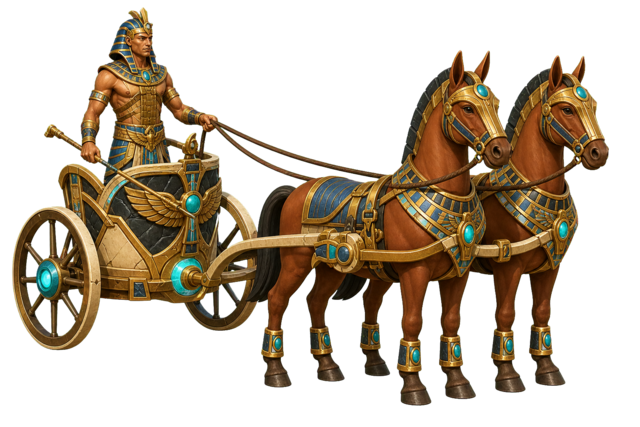
Military & diplomacy
Train spearmen, archers, and chariots from the same working-age population used by the economy. Raids travel across the world map and may target a rival’s stores or pyramid. A defender sees the incoming ruler, objective, route, and arrival time, but formation intelligence remains concealed until resolution.
Combat is resolved at arrival using the exact defending garrison, Guard Towers, covenants, policies, counter matches, and independent attack and defence rolls from 90% to 110%. Troop defence modifiers apply before tower defence is added; the general defence modifier then scales their combined strength. Both sides suffer 15% casualties when victorious or 40% when defeated. Half of casualties, rounded down, recover after 6 hours; the rest are permanent population deaths.
Every troop costs Gold to train and consumes grain while training, ready, deployed, or wounded; the military screen shows both immediate costs and the long-term projected balance. Diplomacy creates other options. Gifts—including Gold—are previewed against the rolling allowance and recipient capacity. An active non-aggression pact blocks raids between its two signatories for seven days.
Monument construction
Limestone and obsidian become stored construction power. A crew of 5–200 citizens converts that reserve into progress at a base rate of 1.8 power per worker-hour. Raid-damaged integrity scales the effective rate from 50% at zero integrity to 100% at full integrity; limestone contributions repair it.
A world has no fixed end date
An early Capstone finish is recorded while the world stays active. At Day 30 the earliest recorded completion wins; after the gate, a new completion freezes the world. The final state remains available for 7 real days before archival.
Practical questions
Yes. Resource production, grain consumption, construction, training, research, trade voyages, population ticks, and an active pyramid crew all resolve from elapsed server time when the village state is refreshed.
Maintenance pauses freeze the authoritative world clock and every timer. Commands become read-only. On resume, deadlines shift by the paused duration so no construction, training, trade, raid, cooldown, or monument time is gained or lost.
Yes. Every new village receives a 72-hour founding shield. Villages founded after the world’s first real day also receive a production bonus—including Gold—that begins at 50% and tapers over 14 days; first-day entrants receive no acceleration.
Only the current incomplete phase can lose progress, subject to the rolling damage allowance. Completed phases are sealed permanently and never become raid targets.
No. Day 30 is only the earliest victory gate. The world stays active until a dynasty has finished the Ascendant Capstone and victory can be resolved. A balance target is not a countdown or guaranteed duration.
Every system is already in motion
Start a village, assign your first workers, and build a dynasty that can commit to Ascension without leaving itself exposed.
Optional analytics
Analytics help us understand which public pages and controls are useful, whether visits lead to account creation or sign-in, which gameplay actions succeed or fail, and where errors happen. We use random browser and visit IDs that are not linked to your Phratek account. Saying no will not affect the website or game.
Names, email addresses, passwords, account, village, world or rival IDs, messages, form values, map coordinates, raw errors, query strings and IP addresses are not added to the analytics dataset.
The random browser ID rotates after 30 days. Accepted raw events are retained centrally for 90 days. When delivery must be retried, the unsent browser queue is capped at 1,000 events or 5 MiB.